Feng Shui · Business / 6 min read
Why Feng Shui May Help You Think Differently About Your Business
A thoughtful walkthrough can reveal what customers and staff need from a space. Use traditional ideas as questions to explore, with practical observations to guide any changes.
Begin with the experience of arriving
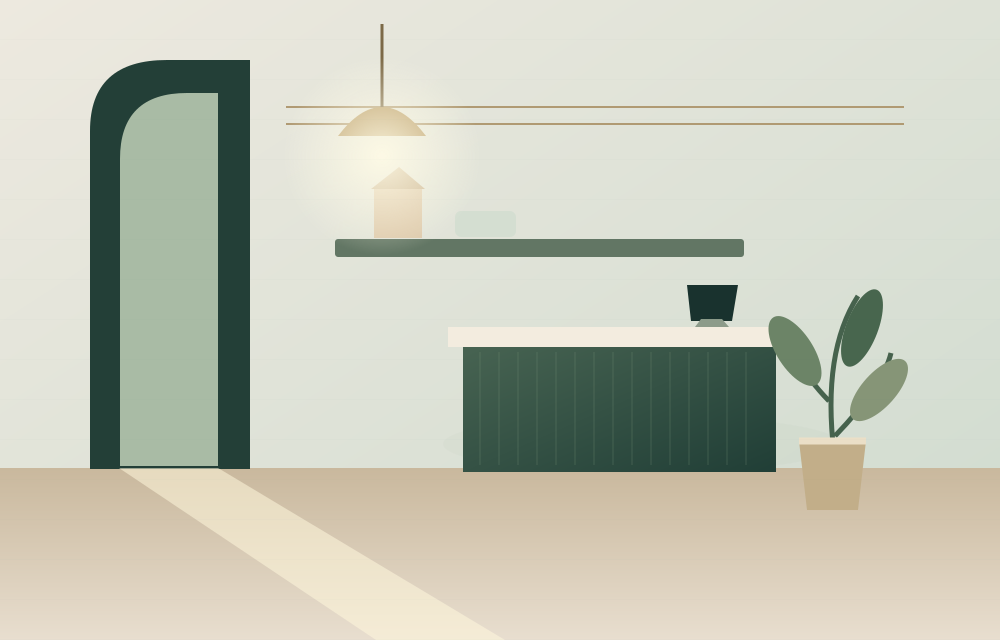
You know where everything is in your business. A first-time visitor does not. That difference is a useful starting point for thinking about the entrance, the counter and the route between them. Before changing the decor, approach the space as someone who has never been there. Can you tell which door to use? Is the business name visible? Can you see where to ask a question without interrupting another customer?
Feng Shui is a Chinese tradition concerned with the relationship between places and their surroundings. Its historical use includes considering the siting and orientation of structures. [1] In a modern business, it can offer prompts for paying closer attention to space. It cannot guarantee more customers, higher revenue or a successful venture.
Keep tradition and practical evidence separate
According to traditional Feng Shui, entrances and working positions can have symbolic significance. Different approaches use different rules, including attention to form or compass direction. [2] Those beliefs are distinct from a practical observation such as a sign being difficult to read.
Suppose customers stop at the door because a display partly hides the reception desk. Moving the display may make reception easier to find. That result supports the change in visibility. It does not establish that an invisible force caused sales to rise. Keeping these explanations separate lets you learn from a tradition without making promises the evidence cannot support.
Look at the entrance from both sides
Entrance orientation can mean the direction a building faces. It can also prompt a more ordinary question: what does someone actually see as they approach? This guide does not assign a profitable compass direction. A lease, neighboring buildings, public access and the shape of the site may leave little freedom to change the entrance anyway.
Start with what is adjustable. Check whether opening information is readable, whether a sign competes with too many other messages, and whether visitors can step inside without immediately meeting a queue. Do not place a decorative object in an exit route. Accessibility, fire safety and local requirements take priority over an aesthetic or traditional preference.
Follow the customer route
Walk from the entrance to a likely browsing point, then to the checkout and exit. Do this at a quiet time and notice what changes when the business is busy. A route that looks clear without people may become awkward when a customer waits with a stroller, a mobility aid or several shopping bags.
You can sketch the room with simple boxes and arrows. Mark places where people have to reverse direction or ask what to do next. The sketch does not need to become a renovation plan. Often a clearer queue entry, one sign or a different place for packaging is enough to test an improvement. Ask staff and customers for feedback voluntarily; do not record private customer information for this exercise.
Make checkout easy to recognize
Two questions matter at the counter: can customers find it, and can staff use it comfortably? A store may experiment with making the entrance clearer and the checkout area easier to see and approach. Keep the payment terminal reachable, protect private information, and avoid creating a queue that blocks browsing or the exit.
A full counter is not automatically a problem. Necessary equipment belongs there. The problem may be competing labels, a stack of old notices or a display that hides the person ready to help. Remove only what is unnecessary, and check that the change does not make the staff's job harder.
Review the owner or manager desk
A traditional command-position preference involves a view toward the entrance with support behind the person and an offset from the direct doorway line. [2] You can consider that preference without treating it as a condition of business success. If it produces screen glare, awkward posture or an exposed confidential display, another arrangement may be better.
Look at the desk as a working system. Can the person reach the things used most often? Is there enough room to change position? Does every interruption require turning around? A small adjustment to a screen or storage area may address the actual problem without moving the desk at all.
Use light and order where they help
Check the places where people read, choose, pay and work. A brighter room is not always a more usable room. A lamp can illuminate a form while also reflecting into a screen or shining into someone's eyes. OSHA's workstation guidance discusses glare, reflections and the placement of lighting. [5] Apply practical checks at the position where the task happens.
Treat clutter as interference with a task, not a moral failing or a prediction of financial trouble. A well-stocked shop can be welcoming. A minimalist shop can still be confusing. Give frequently used items a reachable home and separate information customers need now from information that can be provided when asked.
Run one small experiment
Choose one recurring difficulty, such as customers asking where to pay. Record a simple starting observation, then change one thing. Try a clearer checkout sign for several comparable opening periods. Ask staff whether it helps, count requests for directions, and notice whether the new sign creates another obstacle.
Keep the conclusion modest. Different staffing, promotions, weather and customer numbers can affect what you observe. Keep, adjust or reverse the change based on its usefulness. If a structural or accessibility change is needed, seek appropriate advice rather than improvising a solution from a short guide.
Your next step: choose one point of hesitation in the customer journey. Write down what you will change and what you will observe. Visit martinainc.com for current resources. This article is general education, not a professional premises assessment or financial advice.
Sources & reading notes
References checked 5 October 2026. Examples and exercises are original Martina Inc. educational material.
- The Metropolitan Museum of Art — Nature within Walls: The Chinese Garden Court
Cultural context for Chinese gardens and Feng Shui; not evidence of health or financial effects.
- International Feng Shui Guild — Feng Shui Glossary
Practitioner terminology and variation among traditions; not scientific validation. No definitions or diagrams reproduced.
- Occupational Safety and Health Administration — Computer Workstations: Workstation Environment
Practical guidance on glare, lighting, ventilation and workstation surroundings.